

Expectation Of Higher Bid In Subsequent Auction Cannot Justify Cancellation Of Valid Auction: Supreme Court
The Apex Court reaffirmed that the expectation of fetching a higher price in a future auction is not a legally sustainable ground to cancel an auction that has been conducted in accordance with law and in which the highest bid is above the reserve price.
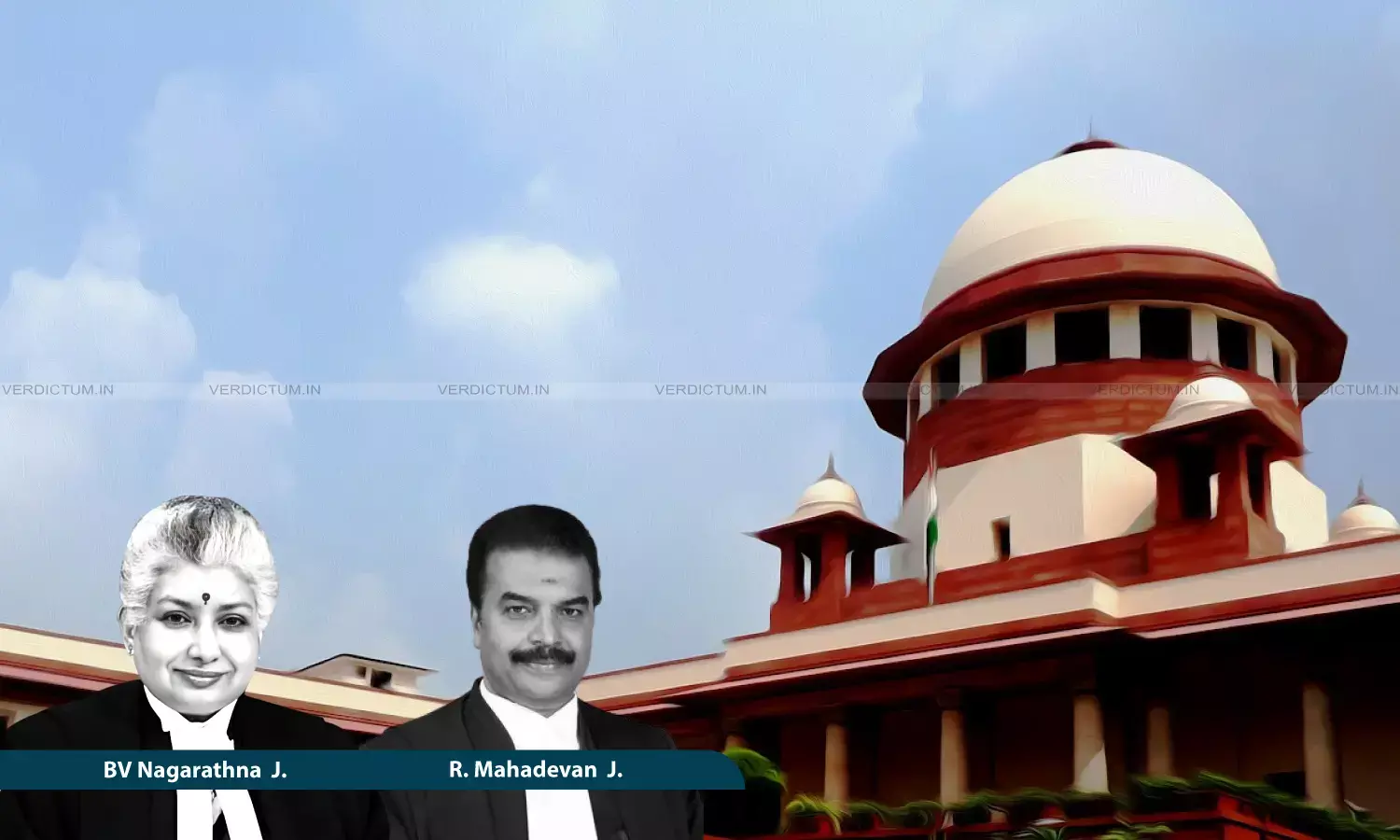
Justice B.V. Nagarathna, Justice R. Mahadevan, Supreme Court
The Supreme Court has held that an auction conducted in accordance with law cannot be cancelled merely on the ground that the auctioning authority expects to secure a higher bid in a subsequent auction, particularly when the highest bid received is above the reserve price, and there is no allegation of fraud, collusion or illegality in the auction process.
The Court was hearing civil appeals arising out of judgments passed by the Allahabad High Court dismissing writ petitions filed by the appellant challenging the cancellation of its highest bid by the Ghaziabad Development Authority in respect of an industrial plot auction.
A Bench of Justice B.V. Nagarathna and Justice R. Mahadevan observed that “expectation of a higher bid in a subsequent auction cannot be a reason to cancel an auction held in accordance with law,” and held that such cancellation on irrelevant considerations is arbitrary and unsustainable.
The appellant was represented by Advocate Siddharth Praveen Acharya, AOR, while the respondents were represented by Advocate Malak Manish Bhatt, AOR
Background
The Ghaziabad Development Authority issued an advertisement for the allotment of various plots through auction, including an industrial plot measuring 3150 square metres under the Madhuban Bapudham Yojana, Ghaziabad. The auction was conducted through a two-bid system comprising technical and financial bids.
The appellant submitted its bids and deposited the requisite earnest money. Its technical bid was approved, and an open auction was held in which the reserve price was fixed at Rs 25,600 per square metre. There were only two bidders for the subject plot. The appellant quoted Rs 29,500 per square metre, which was above the reserve price, and was declared the highest bidder.
Despite being declared the highest bidder, no allotment letter was issued to the appellant. Subsequently, the appellant learnt that the Development Authority had cancelled the auction and proposed to conduct a fresh auction for the same plot, citing the reason that smaller plots under the same scheme had fetched higher prices per square metre.
Aggrieved, the appellant approached the Allahabad High Court seeking directions for the issuance of an allotment letter and execution of a sale deed. The High Court dismissed the writ petitions, holding that the appellant had no indefeasible right to insist on allotment and that the cancellation was justified.
The appellant thereafter approached the Supreme Court.
Court’s Observation
The Supreme Court examined the material on record and noted that the auction was conducted in accordance with law, the appellant’s bid was the highest, and the quoted price was above the reserve price. It observed that there was no allegation of fraud, collusion, suppression or any procedural infirmity in the conduct of the auction.
The Court rejected the justification offered by the Development Authority that higher prices had been obtained for smaller plots under the same scheme. It held that comparing bids received for significantly smaller plots with those for a large plot measuring 3150 square metres was an irrelevant consideration, particularly when the reserve price for both categories of plots had been uniformly fixed.
The Bench observed that demand for smaller plots is naturally higher, whereas demand for larger plots is comparatively limited, which was evident from the fact that only two bidders participated in the auction for the subject plot. In such circumstances, the Authority could not have expected the same per square metre rate as fetched by smaller plots.
Relying on its earlier decisions, including Eva Agro Feeds (P) Ltd. v. Punjab National Bank, the Court reiterated that mere expectation of obtaining a higher price in a future auction cannot be a valid ground to cancel a completed auction. It held that repeated interference in a valid auction process erodes its sanctity and credibility.
The Court further held that once the highest bid above the reserve price had been accepted and declared, the appellant acquired a right to be treated fairly and non-arbitrarily, and the Authority was under a corresponding obligation to proceed with issuance of the allotment letter, in the absence of legally sustainable reasons to cancel the auction.
Furthermore, while stating that “an auction process has a sanctity attached to it and only for valid reasons that the highest bid can be discarded in an auction which is otherwise held in accordance with law”, the Court concluded that “if a valid bid has been made which is above the reserve price, there should be a rationale or reason for not accepting it”.
Conclusion
The Supreme Court held that the cancellation of the appellant’s highest bid by the Ghaziabad Development Authority was arbitrary and based on irrelevant considerations. It found that the High Court erred in upholding the cancellation.
Accordingly, the Supreme Court set aside the impugned judgments of the Allahabad High Court, quashed the cancellation of the auction, and directed the appellant to re-deposit the earnest money.
It further directed the Development Authority to issue an allotment order in favour of the appellant and take all consequential steps to conclude the auction process. The appeals were allowed, with parties directed to bear their own costs.
Cause Title: Golden Food Products India v. State of Uttar Pradesh & Ors. (Neutral Citation: 2026 INSC 22)
Appearances
Appellant: Advocates Siddharth Praveen Acharya, AOR, Aditya Bhati, Lakshay Sharma, Bhuvnesh Vyas
Respondents: Advocates Malak Manish Bhatt, AOR, Neeha Nagpal, Sukanya Joshi
