

Aluminium Shelving For Mushroom Growing Is Liable To Be Classified Under Customs Tariff Item As ‘Aluminium Structures’: Supreme Court
The Supreme Court said that the “mushroom growing apparatus” is not classified as ‘machinery’ and further, that the subject goods are ‘structures’ rather than ‘parts’ of machinery.
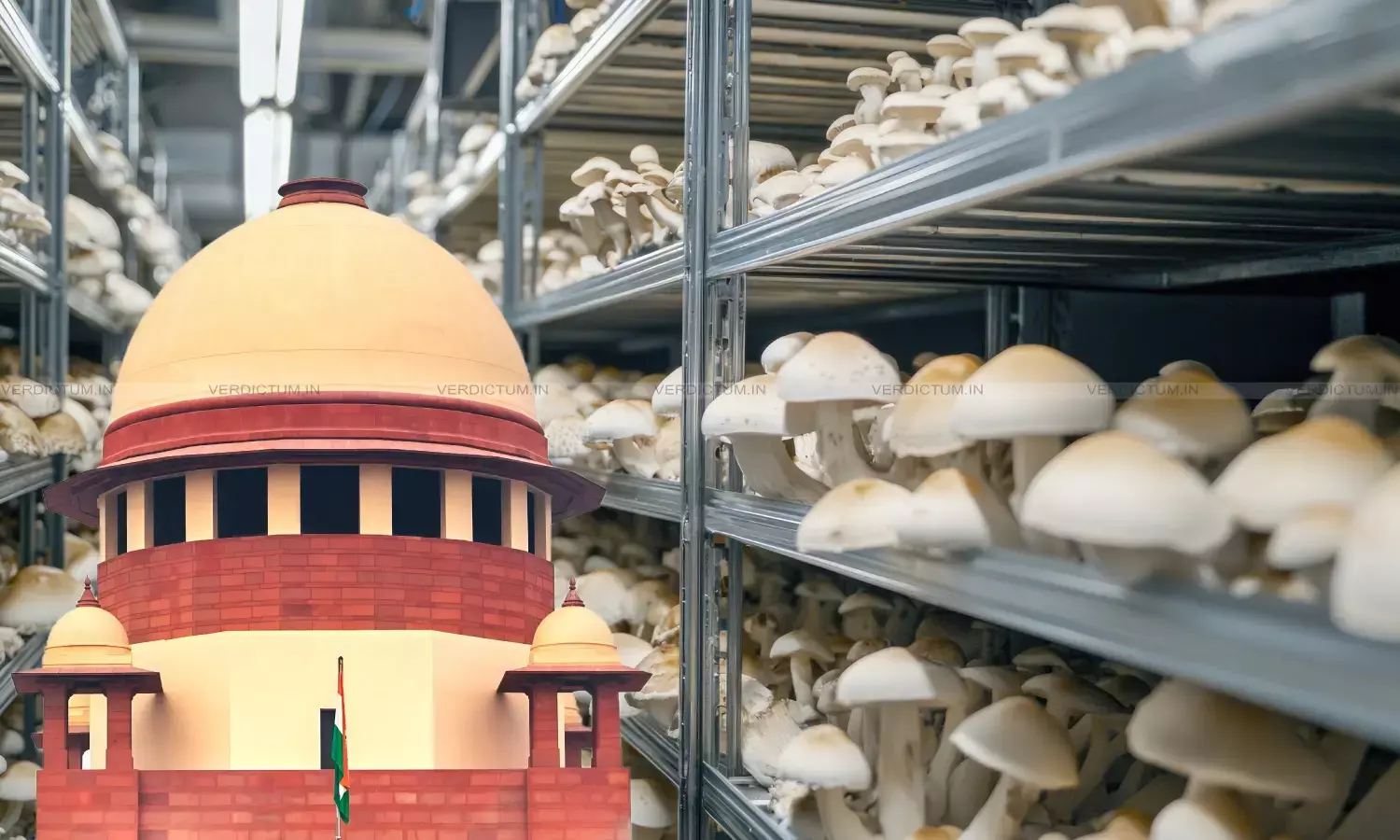
Supreme Court, Aluminium shelves for mushroom growing
The Supreme Court has held that aluminium shelving for mushroom growing is liable to be classified under the Customs Tariff Item as ‘Aluminium Structures’.
The Court held thus in a Civil Appeal preferred against the Judgment of the Customs, Excise and Service Tax Appellate Tribunal (CESTAT), wherein it held that the aluminium shelves imported by a company should be classified under Customs Tariff Item 84369900, as ‘parts’ of agricultural machinery, as opposed to Customs Tariff Item 76109010, as aluminium structures.
The two-Judge Bench of Justice J.B. Pardiwala and Justice R. Mahadevan observed, “… if the goods were indeed classifiable under Chapter Heading 8436 as held by the CESTAT, then the classification dispute is solved by the section note, which excludes goods from Section XVI from the ambit of Section XV. This non sequential application of the GRIs is an error that must be avoided. … Looked at from any angle, we are satisfied that the subject goods cannot be classified under Chapter Heading 8436. Consequently, the subject goods are liable to be classified under CTI 76109010 as ‘Aluminium Structures’.”
The Bench said that the “mushroom growing apparatus” is not classified as ‘machinery’ and further, that the subject goods are ‘structures’ rather than ‘parts’ of machinery.
Advocate Siddhant Kohli appeared for the Appellant, while Advocate Salil Arora appeared for the Respondent.
Factual Background
Customs Tariff Item (CTI) 84369900 carries a nil rate of duty, whereas CTI 76109010 attracts a basic customs duty of 10%, a countervailing duty of 12.5%, a customs cess of 3%, and an additional customs duty of 4% respectively. The Respondent-M/s Welkin Foods imported aluminium shelving along with a floor drain and an automatic watering system and filed a Bill of Entry under Section 46 of the Customs Act, 1962. The Appellant-Commissioner of Customs (Import) accepted the classification of floor drain and automatic watering system under CTI 84369900 as ‘parts’ of agricultural machinery. However, the Audit Scrutiny revealed that the aluminium shelving (subject goods) was a type of aluminium structure and not a ‘part’ of any agricultural machinery and therefore, the revenue ought to have classified the subject goods under CTI 76109010, which would attract a basic customs duty rate of 10%, a countervailing duty rate of 12.5%, customs cess at 3%, and additional customs duty at 4%.
The misclassification caused a short levy of duty amounting to INR 21,01,983, which was recoverable from the Respondent under Section 28(1) of the Act, 1962, along with interest under Section 28AA of the Act, 1962. Consequently, a notice under Section 28(1) of the Act, 1962 was issued to the Respondent. The show-cause notice (SCN) was adjudicated by the Joint Commissioner of Customs and vide adjudication order, the Joint Commissioner held that the subject goods were liable to be classified under CTI 76109010. The Respondent challenged this before the Commissioner of Customs (Appeals) and the said order was affirmed. An Appeal was filed before the CESTAT, which allowed the same and disagreed with two authorities. Being aggrieved, the Appellant approached the Apex Court.
Reasoning
The Supreme Court after hearing the contentions of the counsel, noted, “Upon a bare textual reading of the several headings and chapter/section notes in the Act, 1975, it is clear that for headings in which use is the main consideration or a descriptive factor, the legislature has generally provided a standard of use that is necessary to be achieved by a good to be classified in the said headings. If the notes mandate ‘sole use’, then the good must be such that it can be used only for the purpose envisaged by the heading. Alternatively, if the standard is of ‘principal use’, then the good must be such that it is used predominantly for the purpose envisaged by the heading. Whether the good meets the standard so stipulated can only be decided on a case-to-case basis.”
The Court clarified that where the statute is silent as to the applicable standard of use for headings, then the statutory context of the said tariff heading, i.e., the relevant section and chapter notes, have to be perused to gauge the legislative intent with regard to standard of use i.e., whether the standard of use is that of simpliciter use, principal use or sole use.
“Generally, consideration of ‘use’ in most situations would involve providing proof of at least ‘principal’ use. … However, a note of caution must be struck. The invocation of common or commercial meaning in these interlinked scenarios must strictly adhere to the broad parameters established in the preceding sections of this judgment regarding when the common or trade parlance test can be invoked. Specifically, the common parlance test cannot be used to override or bypass explicit statutory guidance”, it explained.
The Court enunciated that where the statute, through a Section or a Chapter Note, provides a definition or a specific criterion, for example, by prescribing exactly what constitutes “household soap”, “chemical”, “industrial purposes” and “industrial soap”, there is no occasion to resort to commercial understanding.
The Court further summarized the legal position regarding consideration of use when dealing with classification disputes under the First Schedule, Act 1975 as under –
a. ‘Use’ can be considered as a relevant factor when dealing with classification, only if the concerned tariff heading allows for consideration of ‘use’ or ‘adaptation’, either explicitly or implicitly.
b. A tariff entry is said to allow consideration of ‘use’ or ‘adaptation’ for classification in the following scenarios:
i. The tariff heading itself explicitly contains a reference to use or adaptation.
ii. The notes related to a tariff item provide a legal definition or criterion that includes a reference to use or adaptation.
iii. Use or adaptation is inherent in the wording of the tariff entry itself.
iv. The heading is an eo nomine term with no statutory definition, and based on the common or trade parlance test, the Court concludes that the common or commercial meaning of the good includes ‘use’ or ‘adaptation’ of the good as a defining aspect of its identity.
c. Unless statutory intention to the contrary is proven, an importer cannot classify goods based on the actual use to which the goods are put.
d. If the importer wishes to classify goods based on their ‘intended use’, then the following conditions must be fulfilled:
i. First, the tariff heading under which the importer seeks to classify should allow consideration of ‘use’ as a relevant factor;
ii. Secondly, if such a tariff heading allows for consideration of ‘use’, the ‘use’ mentioned in the tariff heading and the ‘intended use’ claimed by the importer must be consistent.
iii. Lastly, the intended use as claimed by the importer:
1. should be inherent in the goods in question and should be discernible from their objective characteristics and properties, which include, among other things, factors such as function, design and composition; and
2. should conform to the standard of use established for that entry.
e. When a tariff heading contains both an eo nomine component and a use component, both criteria must be satisfied. An importer cannot rely on the use criterion to ignore the product's fundamental eo nomine identity.
The Court was of the view that a use limitation cannot be imposed on an eo-nomine provision unless the name inherently suggests use and an eo-nomine provision would ordinarily include all forms of the name article.
“Consequently, Chapter Heading 7610 would cover all forms of aluminium structures, except for prefabricated buildings of heading 94.06, which have been excluded by the heading itself”, it said.
The Court emphasised that tariff headings must be interpreted and construed strictly, i.e., words cannot be added or omitted.
“Section Note 5 does not modify or broaden the scope of the tariff headings themselves. Therefore, if a specific heading, such as Chapter Heading 8436 in this case, refers solely to ‘machinery’ its scope is limited to ‘machinery’ and cannot encompass other types of goods like ‘plant’. An item can only be classified as a ‘plant’ if the relevant heading explicitly includes that term, for example, Chapter Heading 8404 (Auxiliary plant for use with Boilers of Heading 8402 or 8403...) and 8419 (Machinery, Plant or Laboratory Equipment, Whether or not electrically heated...)”, it also observed.
Moreover, the Court held that this mushroom growing apparatus cannot be classified as ‘machinery’ under Chapter Heading 8436.
“In fact, the respondent itself attempted to classify the apparatus as a ‘plant’, a term we have already recognised as distinct from ‘machinery’ and not included within this specific heading. Furthermore, a close examination of the respondent’s submissions clearly shows that they do not advance a case for how the mushroom growing apparatus itself meets the essential, eo nomine, requirement of being ‘machinery’ under Chapter Heading 8436”, it added.
The Court remarked that the subject goods do not fall under Chapter Heading 8436 and the ‘mushroom growing apparatus’ is not classified as ‘machinery’ and further, that the subject goods are ‘structures’ rather than ‘parts’ of machinery.
“Consequently, we find it unnecessary to determine whether the intended use of the subject goods was apparent through their objective characteristics and properties. … Looked at from any angle, we are satisfied that the subject goods cannot be classified under Chapter Heading 8436. Consequently, the subject goods are liable to be classified under CTI 76109010 as ‘Aluminium Structures’.”, it noted.
Conclusion
The Court observed that a classification dispute in the context of imported goods arises when the revenue and the importer disagree on the tariff heading or sub-heading under which the imported goods ought to be classified and in such scenarios, the Tribunals and Courts are tasked with determining the most appropriate heading/sub-heading for the purposes of customs law classification.
“When undertaking this exercise of determining the most appropriate heading, the tribunals and courts are bound by the GRIs, which are provided for in the First Schedule to the Act, 1975 and ought to be applied sequentially. The GRI 1 forms the basis for classifying goods under the First Schedule of the Act, 1975, and establishes the primacy of the notes and terms of headings in determining classification. Thus, any customs law classification dispute at its core would involve interpreting the tariff headings involved, along with the section and chapter notes relevant to such headings”, it emphasised.
The Court held that “mushroom growing apparatus” seems to be a combination of various separate machines, however, on applying the relevant section notes and Explanatory Notes, it appears that mushroom growing apparatus does not qualify as: (i) a composite machine, as different machines are not meant to be fitted together permanently, or (ii) a functional unit, because all the machines do not appear to work together towards a single, clearly defined function and rather, each machine, i.e., the head filling machine, the automatic watering system, and the compost spreading equipment, seems to perform its own independent task.
“The only common element is that they are all part of the broader mushroom cultivation process, which is different from fulfilling a specific, unified function. Thus, mushroom growing apparatus cannot be classified as ‘agricultural machinery’ under Chapter Heading 8436. … Lastly, the subject goods also fail to qualify as parts of the machines with which they are integrated post-importation. … These shelves do not contribute to their operation; they merely serve as a surface for the devices to perform their functions. A surface supports an object but does not become a part of it”, it concluded.
Accordingly, the Apex Court allowed the Appeal and set aside the impugned Judgment.
Cause Title- Commissioner of Customs (Import) v. M/s Welkin Foods (Neutral Citation: 2026 INSC 19)
Appearance:
Appellant: AOR Gurmeet Singh Makker and Advocate Siddhant Kohli.
Respondent: AOR Tahir Ashraf Siddiqui, Advocates Salil Arora, and Mayur Punjabi.
